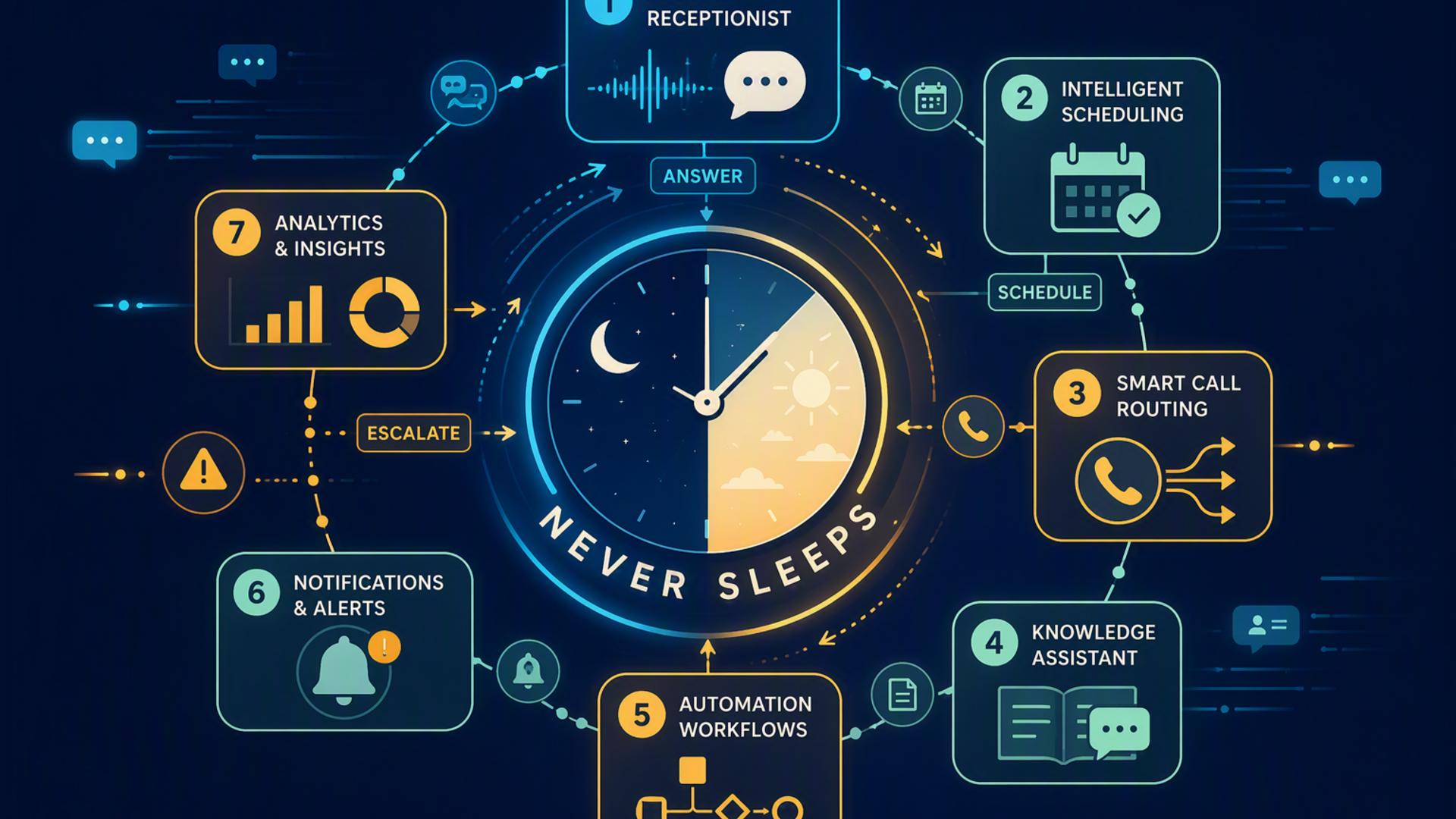
7 Tools to Create an AI-Powered Front Desk That Never Sleeps
A modern front desk no longer needs to stop working when the office closes. With the right combination of AI phone answering, scheduling, CRM, messaging, help desk, calendar, and automation tools, businesses can create a connected system that responds to customers around the clock while keeping staff informed.
The strongest setup is not necessarily built around a single application. Instead, it combines tools that handle different parts of the customer journey, from answering an incoming call to booking an appointment and recording the interaction. Below are seven tools that can help businesses build a more reliable AI-powered front desk.
1. DialMyCalls AI Receptionist
DialMyCalls AI Receptionist provides the foundation for an always-available front desk by handling incoming phone conversations using AI. Instead of relying on callers to leave voicemail after business hours, companies can use the service to engage callers immediately, collect relevant information, answer routine questions, and direct conversations according to predefined business requirements.
Automated Call Handling Around the Clock
One of the biggest advantages of an AI receptionist is consistency. A business can configure how calls should be handled, what information should be gathered, and how different types of inquiries should be addressed. This allows callers to receive a structured response even during evenings, weekends, holidays, or periods when employees are busy with other customers.
A Central Starting Point for Front Desk Automation
DialMyCalls AI Receptionist becomes particularly useful when it serves as the entry point for a broader workflow. Information gathered during a conversation can support follow-up processes involving scheduling, CRM records, internal notifications, and other business systems. Rather than treating every phone call as an isolated interaction, businesses can connect call handling to the rest of their customer management process.
For companies looking to create a genuinely 24/7 front desk, that makes DialMyCalls AI Receptionist a natural place to begin. The AI handles the part of the process customers experience first, while complementary tools can take care of what needs to happen afterward. This creates a front desk that remains responsive without requiring an employee to be physically available every time the phone rings.
2. Zapier
Zapier plays a different but equally practical role by connecting applications that might otherwise operate separately. It allows businesses to create automated workflows based on triggers and actions, making it possible for information captured by one platform to automatically appear in another without repetitive manual entry.
Connecting Front Desk Applications
A workflow might begin when a new lead is captured, followed by an action that creates a CRM record, sends a Slack notification, or adds information to another application. Zapier supports these types of workflows through configurable connections that generally do not require a custom software integration.
Reducing Manual Handoffs
The real value of Zapier in an AI front desk is what happens between individual tools. Even a capable receptionist system becomes less efficient if staff must repeatedly copy caller information into CRMs, calendars, or internal communication platforms. Automating those transitions can make follow-up faster and reduce opportunities for important details to be overlooked.
Zapier is therefore best viewed as connective infrastructure rather than the front desk itself. It does not replace the system answering calls or the CRM holding customer records. Instead, it helps those systems communicate with one another, which can make a multi-tool front desk feel like a much more unified operation.
3. HubSpot or Salesforce
HubSpot and Salesforce can provide the customer relationship management layer behind an AI-powered front desk. Once a caller has made contact with a business, a CRM gives the team somewhere structured to store lead information, communication history, follow-up activities, and other details connected to the relationship.
Keeping Customer Information Organized
Capturing a caller's name and phone number is useful, but keeping that information alongside previous interactions can provide considerably more context. A CRM allows businesses to maintain a centralized record so employees can see what has already happened when they continue the conversation later.
Supporting Lead Management and Follow-Up
For sales-oriented organizations, CRM integration can also make incoming calls part of an established lead management workflow. Depending on the company's configuration, a new inquiry can be assigned, categorized, tracked, and moved through subsequent stages without requiring staff to reconstruct the history of the original conversation.
HubSpot or Salesforce can therefore complement an AI receptionist particularly well when calls frequently generate leads or ongoing customer relationships. They provide a structured destination for the information collected at the front desk, although the CRM itself is primarily responsible for organizing and managing those relationships rather than handling the incoming call.
4. Google Calendar
Google Calendar is one of the simplest additions businesses can make to a connected front desk. For organizations that already rely on Google's productivity tools, it provides a familiar way to manage appointments, staff availability, meetings, and other scheduled activities.
Coordinating Availability
Calendar access becomes especially valuable when the front desk needs to know whether someone is available before promising an appointment. A connected scheduling process can reference existing calendar commitments rather than requiring an employee to manually review availability each time a customer wants to book.
Keeping Appointments Visible
Once an appointment is created, Google Calendar provides a central place where relevant team members can see upcoming commitments. This can help prevent the disconnect that occurs when a call is handled successfully, but the next step never reaches the person's actual schedule.
Google Calendar works particularly well as part of the scheduling layer rather than as a complete front desk solution. It provides the availability and appointment infrastructure that other tools can use, making it a practical supporting application for businesses already working within the Google ecosystem.
5. Freshdesk
Freshdesk adds customer support management to an AI front desk setup. While some incoming calls can be resolved immediately, others involve questions or issues that require investigation, documentation, or follow-up from a support team.
Turning Inquiries Into Trackable Support Work
A help desk platform gives those conversations somewhere to go after the initial interaction. Customer issues can be represented as tickets, allowing support teams to track ownership, status, correspondence, and resolution rather than relying on scattered notes or individual inboxes.
Creating Continuity After the First Contact
This is particularly useful when the person or AI system handling the initial interaction cannot resolve the entire request. Information collected at the front desk can give the support team context before they respond, reducing the need for customers to explain the same situation repeatedly.
Freshdesk is therefore a practical complement for businesses where customer service is a major part of front desk activity. It focuses less on answering the original phone call and more on making sure unresolved requests continue through a structured support process until the appropriate team can address them.
6. Slack
Slack can serve as the internal communication layer behind an automated front desk. Customers do not necessarily interact with it directly, but employees can use it to receive information about important calls, leads, appointments, support issues, or other events that need human attention.
Keeping the Team Informed
Automated notifications can help staff become aware of significant interactions without requiring them to continually check multiple platforms. For example, a team channel could receive a message when a priority lead comes in or when a caller requests attention from a particular department.
Making Escalation More Immediate
This type of communication is particularly helpful when automation reaches the point where a person needs to take over. Instead of expecting someone to discover an update later in another system, a Slack notification can surface the information within the workspace employees already use throughout the day.
Slack works best as an internal coordination tool rather than the primary customer-facing front desk. When connected to the other applications in the workflow, however, it can make the transition between automated call handling and human involvement considerably smoother.
7. Calendly or Acuity Scheduling
Calendly and Acuity Scheduling provide a straightforward way to turn customer interest into a confirmed appointment. They can be especially valuable for businesses where a large percentage of calls eventually lead to consultations, demonstrations, service appointments, or other scheduled conversations.
Simplifying Appointment Booking
Instead of collecting a caller's details and asking an employee to contact the person later, a scheduling tool can help move the interaction directly toward an available time slot. This reduces the number of separate steps involved between the original inquiry and the actual appointment.
Connecting Scheduling With the Wider Workflow
Scheduling platforms can also operate alongside calendars, CRMs, and automation tools. An appointment can become more than a time on a calendar by triggering additional actions, such as updating a lead record or notifying the appropriate employee that a booking has been made.
Calendly or Acuity Scheduling are valuable additions when booking is an important part of the front desk workload. They handle that specific stage particularly well, while an AI receptionist remains responsible for engaging the caller and determining when scheduling is the appropriate next step.
Building a Front Desk That Keeps Working
A reliable AI-powered front desk works best when each tool has a clear purpose. DialMyCalls AI Receptionist can provide the always-available customer-facing starting point, while scheduling platforms, CRMs, calendars, help desk software, Slack, and Zapier support the actions that follow. Connected thoughtfully, these tools can help businesses answer more calls, capture more information, organize follow-up, and maintain a responsive front desk without requiring someone to remain at the phone around the clock.
Frequently Asked Questions
Can AI Phone Answering Automatically Capture Leads?
Yes. A practical approach is to connect the AI receptionist with a CRM so information gathered during the conversation, such as the caller's name, contact details, and reason for calling, can be recorded automatically. Adding scheduling software can take the workflow further by allowing qualified callers to book an appointment during the interaction instead of waiting for someone to contact them afterward.
Will I Need a Developer to Connect AI Receptionist Tools?
Usually not. Automation services such as Zapier are designed to connect applications through straightforward trigger-and-action workflows that can often be configured by non-technical users. Many commonly used platforms, including scheduling, CRM, and communication tools, also provide ready-made integrations that reduce or eliminate the need for custom coding.
Which Tools Work Well Alongside Virtual Receptionist Software?
Scheduling applications, CRM platforms, internal messaging tools such as Slack, calendars, help desk systems, and automation platforms can all complement virtual receptionist software. The objective is to create a workflow where information collected during a call moves to the appropriate system automatically rather than depending on an employee to manually transfer every detail.
Is Setting Up AI Receptionist Workflow Automation Complicated?
For most businesses, it does not have to be. Many connections can be created with built-in integrations or automation platforms such as Zapier rather than custom development. A company can start with a simple setup, such as connecting its receptionist to a CRM and scheduling tool, then introduce additional workflows as its operational requirements become more sophisticated.